
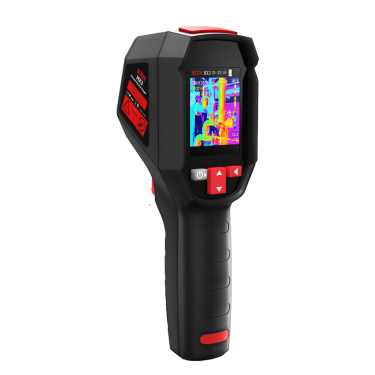
# Infrared Thermometer: A Comprehensive Guide to Non-Contact Temperature Measurement
## Introduction to Infrared Thermometers
Infrared thermometers, also known as non-contact thermometers or laser thermometers, have revolutionized temperature measurement across various industries. These devices measure temperature by detecting the infrared energy emitted by all objects above absolute zero. Unlike traditional thermometers that require physical contact, infrared thermometers provide instant readings from a safe distance.
## How Infrared Thermometers Work
Infrared thermometers operate on the principle of black body radiation. Every object emits infrared energy based on its temperature. The thermometer’s optics collect this infrared radiation and focus it onto a detector, which converts the energy into an electrical signal. This signal is then processed and displayed as a temperature reading.
Key components include:
– Optical system (lens)
– Infrared detector
– Signal processing unit
– Display screen
## Advantages of Non-Contact Temperature Measurement
Infrared thermometers offer numerous benefits:
1. **Safety**: Measure temperatures of hazardous, moving, or hard-to-reach objects without contact
2. **Speed**: Provide instant readings (typically within 1 second)
3. **Hygiene**: Ideal for medical and food applications where contamination must be avoided
4. **Versatility**: Can measure extremely high or low temperatures that would damage contact thermometers
5. **Durability**: No moving parts that can wear out from repeated contact
## Common Applications
Infrared thermometers are used in diverse fields:
### Medical Applications
– Fever screening (especially during pandemics)
– Body temperature measurement
– Detection of inflammation in tissues
### Industrial Uses
– Monitoring machinery and electrical equipment
– HVAC system maintenance
– Automotive diagnostics
– Manufacturing process control
### Food Service
– Checking food temperatures without contamination
– Monitoring refrigeration units
– Ensuring proper cooking temperatures
### Scientific Research
– Environmental monitoring
– Material science experiments
– Astronomical observations
## Choosing the Right Infrared Thermometer
When selecting an infrared thermometer, consider these factors:
1. **Temperature Range**: Ensure it covers your required measurement range
2. **Distance-to-Spot Ratio**: Determines the measurement area at various distances
3. **Emissivity Settings**: Important for measuring different materials accurately
4. **Response Time**: How quickly it provides readings
5. **Accuracy**: Typically ±1-2% of reading or ±2°C (±4°F)
6. **Additional Features**: Data logging, alarms, laser pointers, etc.
## Proper Usage Techniques
Keyword: infrared thermometer
To get accurate readings:
1. Know the emissivity of your target material
2. Keep the lens clean and free of scratches
3. Measure within the specified distance range
4. Avoid measuring through glass or other transparent barriers
5. Account for environmental factors like steam, dust, or smoke
6. Allow the thermometer to acclimate to extreme ambient temperatures
## Limitations and Considerations
While infrared thermometers are incredibly useful, they have some limitations:
– Cannot measure internal temperatures (only surface temperatures)
– Affected by reflective surfaces and emissivity variations
– Require clear line of sight to target
– May be affected by ambient temperature extremes
– Not suitable for measuring air or gas temperatures directly
## Maintenance and Care
To ensure long-term accuracy:
1. Store in a clean, dry place
2. Clean the lens regularly with appropriate materials
3. Avoid extreme temperature shocks
4. Replace batteries promptly when low
5. Periodically verify calibration against known temperature sources
## Future Developments
Infrared thermometer technology continues to evolve with:
– Improved accuracy and resolution
– Smart connectivity (Bluetooth, WiFi) for data logging
– Advanced image processing for thermal mapping
– Miniaturization for portable applications
– AI-assisted diagnostics and pattern recognition
## Conclusion
Infrared thermometers have become indispensable tools across numerous fields, offering fast, safe, and non-invasive temperature measurement. By understanding their principles, proper usage techniques,