
# Rain Gauge: A Comprehensive Overview of Its Design and Functionality
## Introduction to Rain Gauges
A rain gauge is a meteorological instrument used to measure the amount of liquid precipitation over a set period of time. These devices have been essential tools for weather monitoring, agriculture, hydrology, and climate research for centuries. Understanding how rain gauges work and their various designs helps us appreciate their importance in weather data collection.
## Basic Components of a Rain Gauge
All rain gauges share some fundamental components:
– Collector funnel: Gathers precipitation and directs it into the measuring mechanism
– Measuring cylinder: Holds and measures the collected precipitation
– Overflow reservoir: Catches excess water when the measuring cylinder fills
– Mounting bracket: Secures the gauge in an optimal position for accurate measurement
## Types of Rain Gauges
### Standard Rain Gauges
The most common type features a funnel that collects rain and directs it into a narrow measuring tube. The cross-sectional area of the funnel is typically ten times that of the tube, allowing for precise measurement of small amounts of precipitation.
### Tipping Bucket Rain Gauges
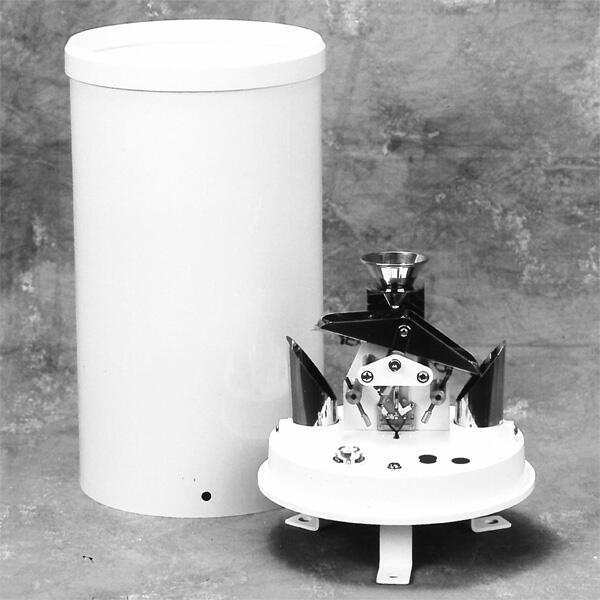
These electronic gauges use a small seesaw-like container that tips when it fills with a specific amount of water (usually 0.01 inches or 0.2 mm). Each tip is recorded electronically, providing real-time rainfall data.
### Weighing Rain Gauges
These sophisticated instruments measure precipitation by weight. They’re particularly useful for measuring snowfall as well as rain, as they can record the water equivalent of frozen precipitation.
### Optical Rain Gauges
Using laser or infrared technology, these gauges detect raindrops passing through a sensing area. They can measure both rainfall intensity and drop size distribution.
## Proper Installation and Maintenance
For accurate measurements, rain gauges must be:
– Placed in an open area, away from trees, buildings, and other obstructions
– Positioned at the correct height (typically 1-2 feet above ground)
– Regularly cleaned to prevent debris buildup
– Checked for proper calibration
## Applications of Rain Gauge Data
Rainfall measurements serve numerous purposes:
– Weather forecasting and climate modeling
– Agricultural planning and irrigation management
– Flood prediction and water resource management
– Hydrological studies and watershed analysis
– Urban planning and infrastructure design
## The Future of Rain Measurement
Modern rain gauges are increasingly incorporating wireless technology and IoT capabilities, allowing for remote monitoring and data collection. Some advanced systems now combine traditional rain gauges with radar and satellite data for more comprehensive precipitation measurement networks.
Despite technological advancements, the basic principle of the rain gauge remains unchanged – capturing and measuring precipitation to help us understand and respond to our changing environment.
Keyword: rain gauge description